A product of TwinStance Solutions LLP ยท LLPIN: AAQ-0042 ยท Est. July 2019 ยท Cuttack, Odisha
๐Ÿ›ก๏ธ Defence Grade ยท IAF Compatible ยท Offline First

WYNTIQ for the
Indian Air Force

India's first offline-capable, AI-powered Integrated Material Management System built specifically for IAF aircraft maintenance, spare parts procurement, and multi-base logistics โ€” replacing paper-based demand signals with a fully digital, fully accountable workflow that works even in Ladakh, Andaman, and Northeast India where connectivity is unreliable.

130+
IAF Air Bases
1,700+
IAF Aircraft
โ‚น6.2L Cr
Defence Budget
100%
Offline Capable
The Problem

Aircraft Grounded. Parts Missing. No Accountability.

The Indian Air Force is one of the largest and most capable air forces in the world. With over 1,700 aircraft spread across more than 130 air bases, air force stations, and advanced landing grounds, the IAF represents an extraordinary investment in national security. Yet one of the biggest threats to IAF operational readiness is not from adversaries โ€” it is from within. It is the chronic inefficiency of spare parts management and logistics.

Every year, IAF aircraft spend thousands of cumulative hours on the ground โ€” not because they are being maintained, but because the right spare part has not arrived. A technician identifies a faulty component, raises a demand, and then waits. The demand travels slowly through the system โ€” on paper, through phone calls, through manual registers โ€” each step adding hours, sometimes days, to what should be a straightforward transaction.

Consider what happens when an AN-32 transport aircraft is grounded at Jorhat Air Force Station in Assam with a failed fuel pump. The technician identifies the fault, fills in a paper demand signal, and submits it to the Duty Officer. The officer reviews it the next morning, approves it, and passes it to the Logistics section. Logistics checks the store register โ€” manually โ€” and finds the part is not in stock at Jorhat but may be available at Bagdogra, 200 kilometres away. A phone call is made. Confirmed. A transfer is initiated through channels. Meanwhile the aircraft sits. The mission is delayed. The crew is on standby. The cost โ€” direct and indirect โ€” mounts.

This is not an isolated incident. This is the daily reality of IAF logistics at the unit level. And it happens not because of lack of effort or competence, but because of a fundamental absence of the right technology โ€” technology that gives everyone in the chain real-time visibility, instant notifications, and the ability to act without waiting for paper to travel from desk to desk.

The IMMOLS Gap
The IAF introduced IMMOLS โ€” Integrated Materials Management Online System โ€” developed by Tata Consultancy Services. IMMOLS was a significant modernisation step. It digitalised many processes that were previously entirely paper-based. However, IMMOLS was designed when internet connectivity at all IAF stations was assumed. Today, that assumption does not hold. Forward Operating Locations in Ladakh at altitudes above 4,000 metres, Advanced Landing Grounds in the Andaman and Nicobar Islands, and stations in remote parts of Arunachal Pradesh and Nagaland frequently face connectivity disruptions. When the internet is unavailable, IMMOLS becomes unavailable. Operations revert to paper. All the modernisation gains are lost precisely at the moments when they are needed most โ€” during operations, during emergencies, during exactly the situations where speed and visibility matter.

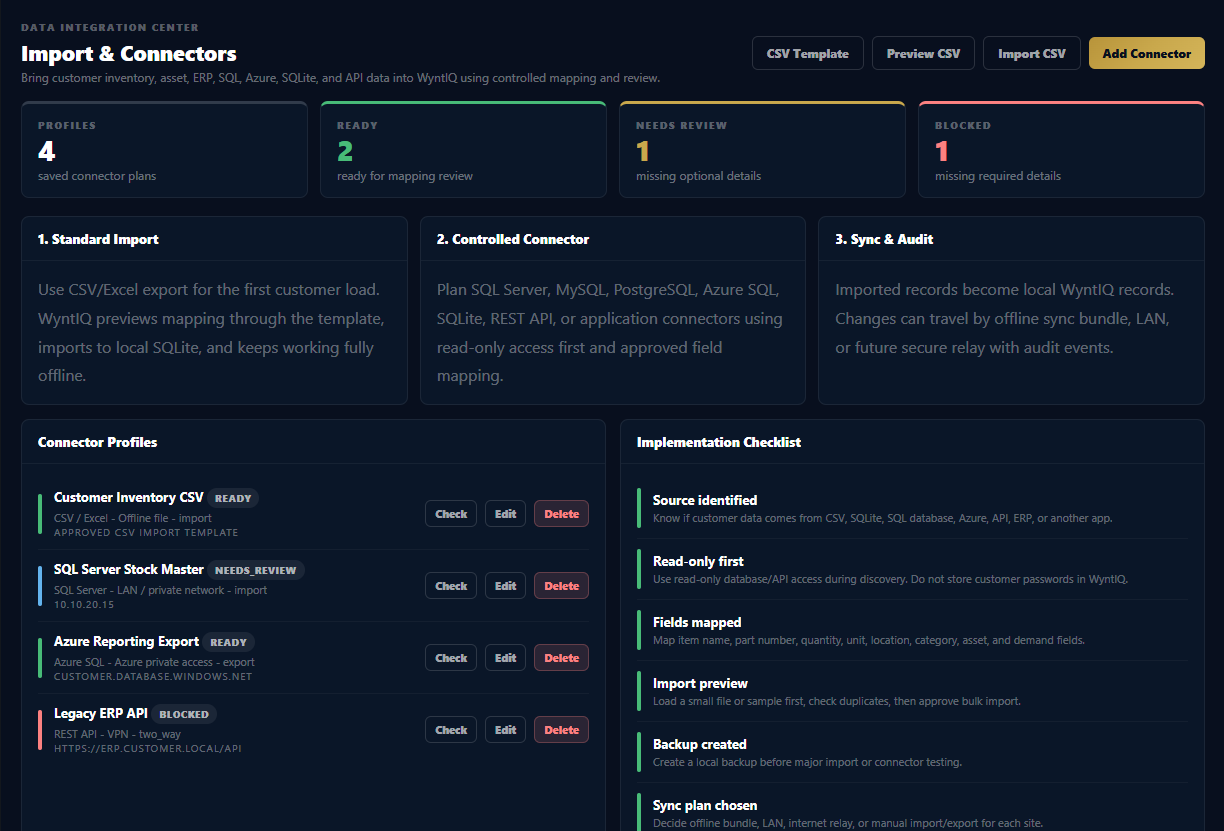
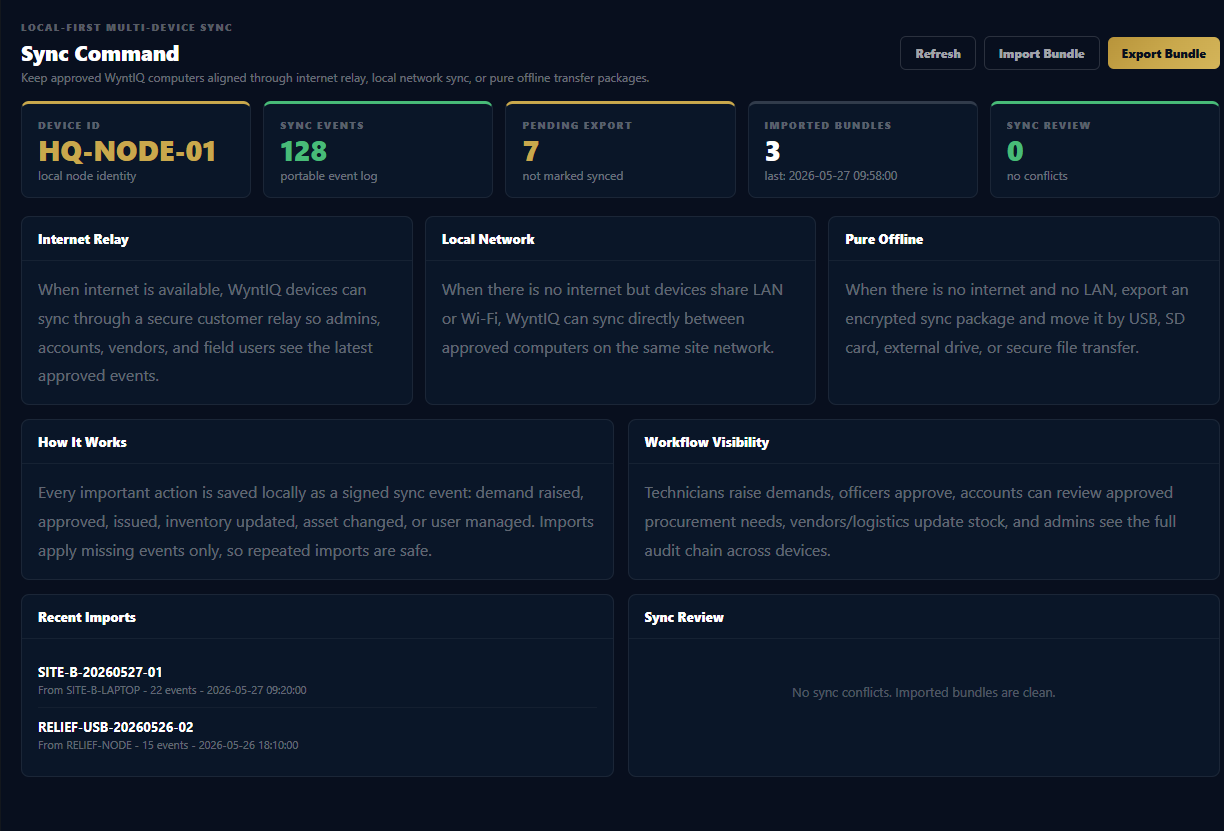
WYNTIQ was built to solve this gap. It does not require internet to function. It is built offline-first โ€” meaning the system was designed from the ground up to work without connectivity, and to synchronise data automatically and intelligently when connectivity becomes available. This is not a backup mode or a degraded mode. The full system โ€” demand signals, approvals, inventory checks, issue tracking, audit logging โ€” runs identically whether connected or not.

Beyond the connectivity problem, there is a deeper accountability problem. In the current paper-based system, tracing a demand from initiation to completion is time-consuming and often impossible after the fact. Who raised the demand? Which officer approved it? When did it reach logistics? Why was there a three-day gap between accounts approval and the vendor being contacted? These questions cannot be answered reliably with paper records. They can be answered instantly with WYNTIQ โ€” because every action, by every person, at every stage, is recorded with a timestamp and cannot be altered.

โŒ Current Reality
Aircraft grounded for 2-5 days waiting for spare part approval through paper-based demand signal chain. Officer unavailable, form sitting on desk, no visibility for anyone upstream.
โœ… With WYNTIQ
Demand raised digitally in 90 seconds. Officer notified instantly on device. Approval in minutes. If part in stock โ€” issued same day. If not โ€” vendor PO auto-generated. Full visibility for all stakeholders.
โŒ Current Reality
IMMOLS goes down when internet fails. Forward bases in Ladakh and Andaman revert to paper. No real-time inventory data. No cross-base visibility. Every decision based on incomplete information.
โœ… With WYNTIQ
Full system operates offline. Data stored locally on device. Syncs automatically when connectivity returns. No degraded mode โ€” full functionality in Siachen or Andaman without any connectivity.
โŒ Current Reality
No audit trail for parts usage. Cannot determine who authorised a particular issue, why a demand took 4 days, or which officer was responsible for a delay in a critical aircraft's maintenance.
โœ… With WYNTIQ
Every action permanently logged โ€” who raised, who approved, who issued, exact time at each stage. Cannot be edited or deleted. Exportable as CSV for MCI audit, CAG audit, or Command inspection.
How It Works

From Demand Signal to Aircraft Back in Service

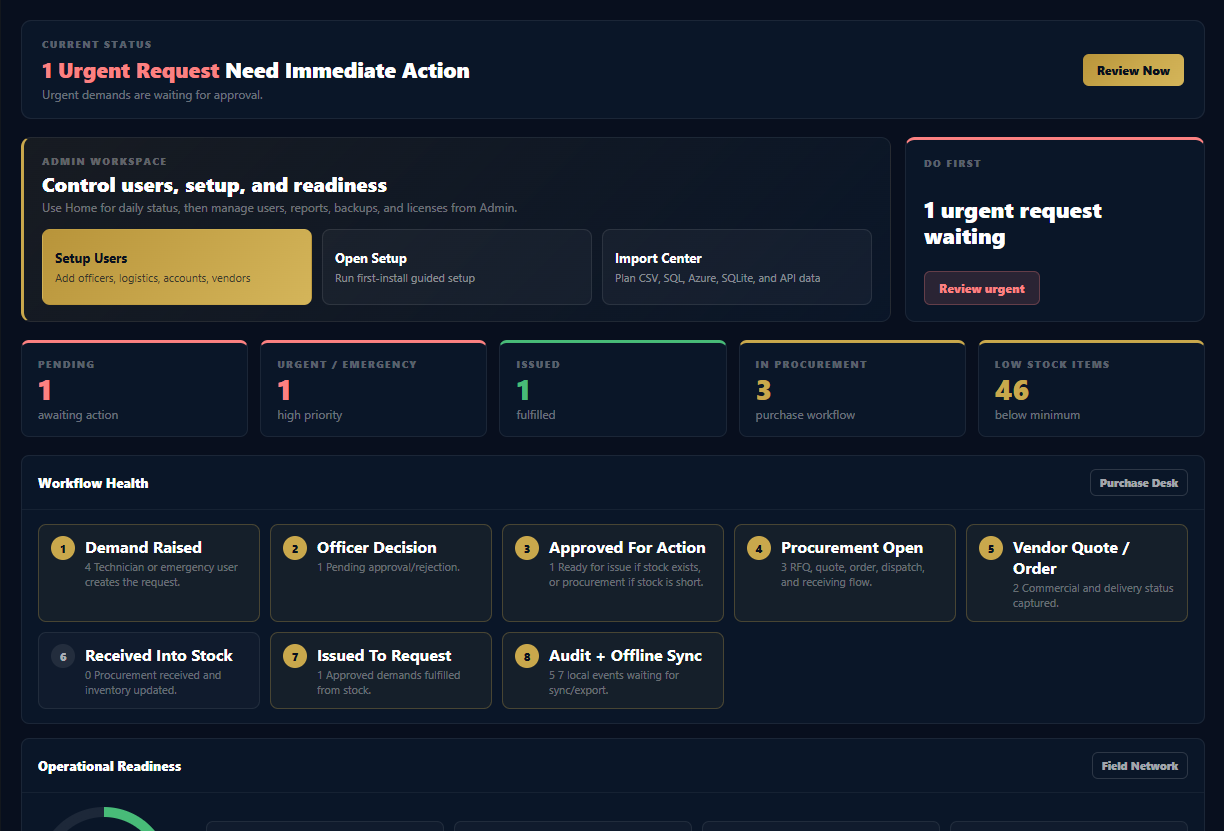
WYNTIQ digitalises the entire IAF material management workflow โ€” from the moment a technician identifies a defect to the moment the aircraft is back in service. Every step is tracked, every person is accountable, and the system is intelligent enough to skip unnecessary steps when they are not needed.

The workflow in WYNTIQ is built around how the IAF actually operates โ€” not how a Western logistics system assumes it should operate. The system recognises the IAF's existing role structure: technicians and ground crew who identify defects and raise demands; engineering officers who authorise procurement; logistics sections that manage stores and issue parts; accounts sections that control budget; and vendors or depots that supply items not held in unit stores. Each role has a specific, clearly defined function in the system, and each person sees only what they need to see to do their job.

1
Technician Identifies Defect and Raises Demand Signal
A ground crew technician or engineer identifies a fault during a scheduled inspection or after a sortie. He opens WYNTIQ on his tablet or mobile device โ€” which works offline without any internet connection. He selects the aircraft by tail number, enters the work order reference, selects or types the part name, enters the part number, specifies the quantity required, selects the priority level (Routine, Urgent, or Emergency), and writes a brief justification. The entire demand signal is created in approximately 90 seconds. This replaces the paper DA Form 1262 or equivalent. The demand signal is assigned a unique ID โ€” for example DS-047-JAT-2026 โ€” and immediately appears in the Engineering Officer's queue for review.
2
WYNTIQ Automatically Checks Store Inventory First
Before routing the demand to anyone for approval, WYNTIQ automatically checks the unit's store inventory. If the required quantity is available in the unit store, the system flags this immediately. For many routine maintenance demands, the item will be in stock โ€” in these cases, the system can route the demand directly to Logistics for issue without requiring Officer approval at all. This is a critical feature: for items in stock, WYNTIQ eliminates unnecessary steps and issues the part directly. The Officer approval chain is reserved for cases where procurement from outside the unit is required โ€” which is when it genuinely matters and where officer oversight adds real value.
3
Engineering Officer Reviews and Approves
When officer approval is required โ€” because the item is not in stock or is above the Logistics section's self-approval threshold โ€” the Engineering Officer receives an instant notification on his device. He can review the demand โ€” seeing the aircraft tail number, defect description, part required, quantity, justification, and priority โ€” and approve it with a single tap. If he has questions, he can add a note. If he rejects it, he must provide a reason that is permanently recorded. The average officer approval time in WYNTIQ demo deployments is under 4 minutes for routine demands and under 60 seconds for emergency demands. Compare this to the current system where demands sit in physical in-trays for hours or days.
4
Logistics Section Processes the Demand
With officer approval confirmed, the demand appears in the Logistics section's queue. The logistics officer or NCO can see the demand details, the officer's approval, and the current inventory position for the required item. If the item is available in store โ€” perhaps restocked since the automatic check โ€” it is issued directly. The system records the issue against the specific demand, the specific aircraft, and the specific work order. Stock is automatically decremented. If the item is not available at the unit level, the logistics section checks whether it is available at the base's main stores, at a nearby unit, or needs to be procured from a depot or vendor.
5
Accounts Section Approves Procurement Budget
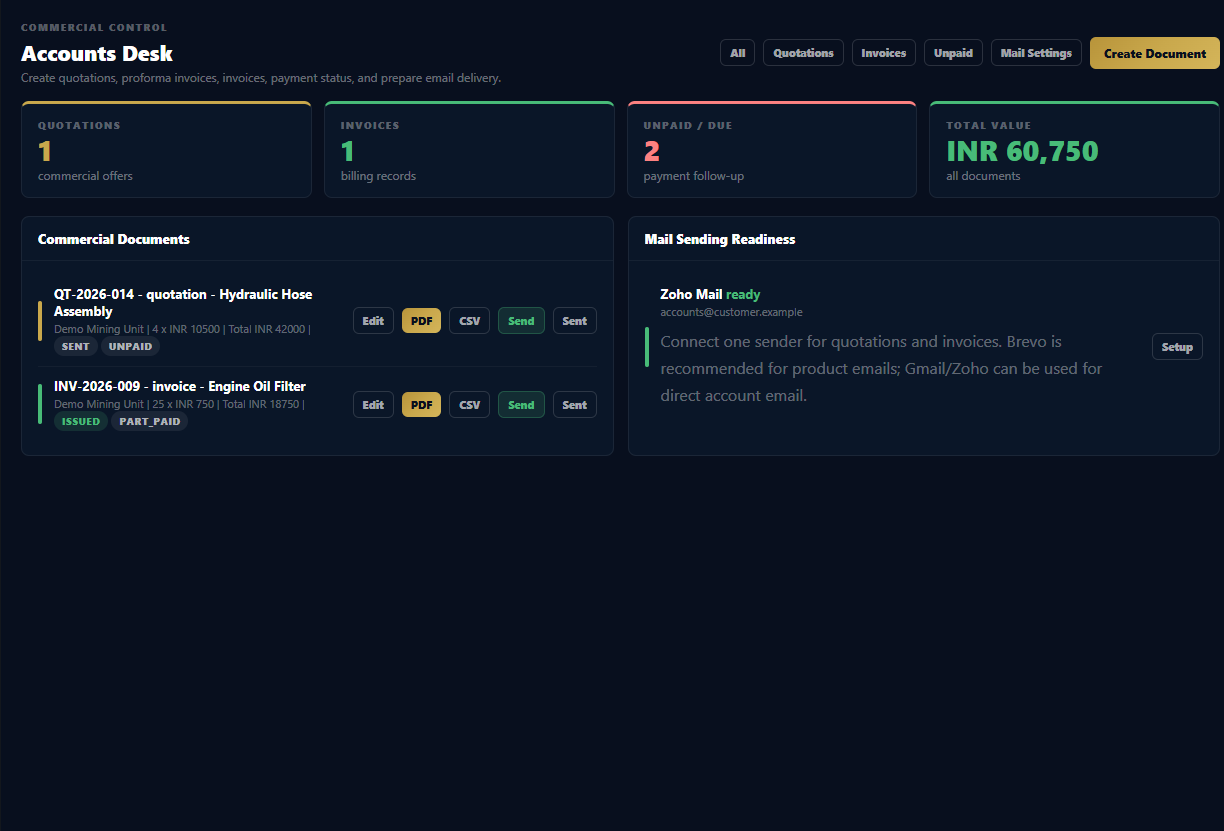
When procurement from an external source is needed, the demand is forwarded to the Accounts section with a cost estimate. The accounts officer reviews the budget position and approves the expenditure. This is done digitally, with the budget reference and approval authority clearly recorded. WYNTIQ maintains a running budget utilisation view for the accounts section, so approval decisions are made with full financial context โ€” not based on paperwork that may be days old. Once accounts approval is confirmed, WYNTIQ automatically generates a Purchase Order that is sent to the approved vendor.
6
Vendor Supplies and Stock is Updated
The approved vendor receives the Purchase Order through WYNTIQ. When the items arrive, receipt is recorded in the system by the stores staff. Stock is automatically updated. The received quantity is immediately checked against the pending demand and the required items are issued to the technician. The entire chain โ€” from demand raised to item in technician's hands โ€” is complete. The audit trail is permanent, complete, and immediately available for any inspection or review.
Platform Capabilities

Every Feature Built for IAF Operations

WYNTIQ is not a generic logistics platform adapted for defence. Every feature has been designed with IAF operational requirements in mind โ€” from the way demand signals are raised to the way audit logs are formatted for MCI and CAG inspections.

โœˆ๏ธ
Aircraft-Tagged Demand Signals
Every demand is linked to a specific aircraft tail number and work order. The system maintains a complete maintenance demand history for every aircraft โ€” what was demanded, when, by whom, what was the outcome. When an aircraft goes in for major servicing, its entire demand history is available instantly. This information helps identify recurring defects, problematic components, and maintenance patterns that can inform procurement planning and lifecycle decisions.
๐Ÿ“ก
True Offline Operation
WYNTIQ operates identically whether connected or disconnected. At a forward operating location with no internet โ€” Daulat Beg Oldie at 5,065 metres, Car Nicobar Island, or Mechuka in Arunachal Pradesh โ€” the full system functions. Demand signals are created, approved, and processed. Inventory is tracked. Audits are logged. When connectivity returns, all data synchronises automatically with the central server. No action taken offline is lost. No data is corrupted. The synchronisation is intelligent โ€” it resolves conflicts based on timestamps and role hierarchy.
๐Ÿช
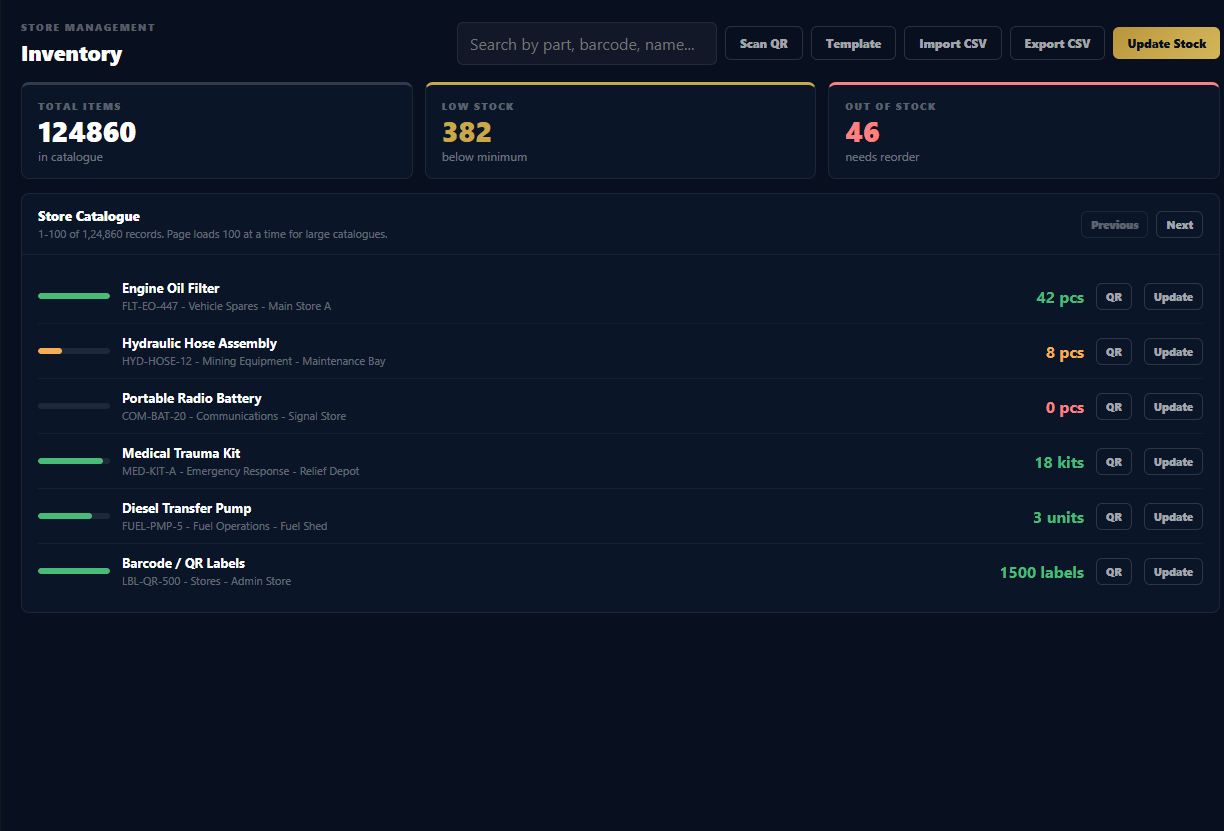
Multi-Base Inventory Visibility
A logistics officer at Pathankot Air Force Station can see real-time inventory at Pathankot, Adampur, Halwara, and other nearby bases โ€” simultaneously. If a critical part is out of stock at Pathankot but available at Adampur, a lateral transfer request can be raised and approved without any phone calls. The system tracks the transfer as a specific transaction with its own chain of custody, ensuring accountability even for movements between units. This cross-base visibility is one of the most powerful features for reducing the overall spare parts holding across a command area while maintaining availability.
โšก
Scramble Mode Override
In genuine operational emergencies โ€” when aircraft must be returned to service in the shortest possible time regardless of normal approval procedures โ€” the Station Commander or designated authority can activate a Scramble Override for a specific aircraft and specific parts. Under Scramble Override, parts are issued immediately from store without waiting for the normal approval chain. However, the override itself is logged with the authorising officer's credentials, the time, the justification, and all parts issued. Accountability is maintained even in emergency situations. The override cannot be activated by a technician or logistics officer โ€” it requires command-level authority.
๐Ÿ”ฎ
Predictive Procurement Intelligence
WYNTIQ analyses historical demand patterns combined with the current serviceability schedule and flight hours data to generate procurement recommendations. If AN-32 aircraft at a particular station have historically required fuel pump replacements every 800 flight hours, and the current fleet is approaching that threshold, WYNTIQ will flag this and recommend initiating procurement โ€” before the part fails, before the demand is raised, before the aircraft is grounded. This predictive capability turns reactive maintenance into proactive maintenance, which is the single most impactful change possible in aviation logistics management.
๐Ÿ“Š
Serviceability Dashboard
The Station Commander's view in WYNTIQ shows the current serviceability status of every aircraft at the station โ€” not just which are serviceable and which are grounded, but why the unserviceable aircraft are grounded, which parts are pending, which demands are in the system for each grounded aircraft, and the expected time to return each aircraft to service based on the status of pending demands and vendor delivery timelines. This gives the Station Commander a genuine operational picture rather than a historical snapshot, enabling better mission planning and resource allocation.
๐Ÿ”
Tamper-Proof Audit Trail
Every action in WYNTIQ is logged permanently. Who raised a demand, at what time, from which device. Who approved it, at what time, with what note. Who issued the parts, in what quantity, against which aircraft. Who received them. How long each step took. This log cannot be edited, cannot be deleted, and cannot be selectively modified. It is exportable as a CSV file for any inspection โ€” MCI audit, CAG audit, Command inspection, or Court of Inquiry. The log provides definitive answers to questions that currently take weeks to investigate through paper records.
โฑ๏ธ
Time-to-Complete Tracking
WYNTIQ measures and records how long each stage of the demand fulfilment process takes โ€” time from demand raised to officer approval, time from officer approval to logistics processing, time from logistics to accounts approval, time from accounts approval to vendor PO, time from PO to delivery. These metrics are aggregated and reported, allowing Command headquarters to identify systemic bottlenecks. If 70% of demand delays are occurring at the Officer Approval stage across a particular Command, that is actionable intelligence that the Command can use to drive improvement.
๐Ÿง 
Bottleneck Detection and Reporting
Beyond tracking time at each stage, WYNTIQ analyses patterns and generates bottleneck reports automatically. These reports identify which roles, which individuals, which bases, and which categories of demand are causing the most delays. The system presents this data clearly โ€” "Officer approval at Station X averages 3.2 days versus the Command average of 0.8 days" โ€” with enough specificity to enable targeted intervention. This is the kind of management intelligence that is currently impossible to generate from paper records, and that enables headquarters to drive continuous improvement in operational readiness.
Accountability

Who Did What. When. Why. No Hiding.

The most consistent feedback from defence logistics professionals is that the biggest problem is not the absence of systems โ€” it is the absence of accountability. Parts go missing. Demands disappear. Approvals are inexplicably delayed. Stores records do not match physical holdings. And because everything is on paper, it is impossible to determine definitively what happened, when, and who was responsible. WYNTIQ changes this fundamentally.

In WYNTIQ, every transaction is associated with a specific user account. Every user account is associated with a specific person โ€” their rank, their name, their role, their station. When a demand is raised, the system knows exactly who raised it. When it is approved, the system knows exactly who approved it and at what time. When a part is issued from store, the system records who issued it, from which store location, in what quantity, against which specific demand and work order. When a part is received from a vendor, the receipt is recorded against the vendor and the delivery challan number.

This creates a complete, permanent, unalterable record of every transaction. Unlike paper records that can be lost, misfiled, overwritten, or selectively presented during an inspection, the WYNTIQ audit log is always complete, always accurate, and always available. A Commanding Officer who wants to know why a particular aircraft was grounded for six days can open WYNTIQ and trace the entire journey of every demand related to that aircraft โ€” seeing exactly where time was lost, which approvals were slow, and whether the eventual resolution was optimal.

For Courts of Inquiry, for CAG audits, for MCI inspections, WYNTIQ provides the definitive record. The audit log can be exported as a CSV file in seconds โ€” providing a structured, sortable, complete record of all transactions for any time period, for any station, for any aircraft, for any individual. Generating the same information from paper records might take weeks of manual searching. With WYNTIQ it takes seconds.

100%
Actions Logged
0
Records Can Be Deleted
CSV
Export Format
<10s
Time to Generate Audit Report
Predictive Intelligence

Know Before the Problem Happens

Reactive maintenance โ€” fixing things after they break โ€” is the most expensive and operationally disruptive approach to aircraft maintenance. Every major air force in the world is moving toward predictive and condition-based maintenance, where systems flag potential issues before they cause failures. WYNTIQ contributes to this goal through its predictive alerting capabilities.

WYNTIQ monitors inventory levels continuously and generates alerts when stock levels approach minimum thresholds. For a part that typically takes 14 days to procure, WYNTIQ will generate an alert when the stock level drops to the point where, at the current demand rate, the remaining stock will last less than 21 days. This provides a safety buffer of one week โ€” enough time to initiate procurement before the part runs out, rather than after an aircraft has already been grounded.

Beyond simple minimum stock alerts, WYNTIQ analyses demand patterns to identify seasonal and operational cycle trends. Certain parts may be demanded more frequently during periods of high flying activity โ€” pre-exercise periods, during summer when flying hours are typically higher, or at specific points in the maintenance calendar. By identifying these patterns, WYNTIQ can recommend that procurement be initiated earlier than a simple minimum stock calculation would suggest, ensuring that stocks are built up before predicted peaks in demand.

The system also generates alerts for demands that are approaching deadline without resolution. If an Urgent demand has been in the system for 24 hours without being fulfilled, WYNTIQ generates an alert and escalates the notification to a higher authority. If an Emergency demand has been unresolved for more than 2 hours, immediate notification goes to Command level. This ensures that critical aircraft maintenance is never silently delayed โ€” delays are always visible, always flagged, and always escalated.

๐Ÿ“‰ Stockout Prediction
WYNTIQ predicts stockouts before they happen. Based on current stock level, average daily demand rate, and procurement lead time, the system calculates the date on which a stockout will occur if procurement is not initiated. This date is displayed prominently for logistics officers, with a clear recommendation on when to initiate procurement to maintain the desired safety stock level. No part should ever run out unexpectedly when WYNTIQ is running.
โšก Demand Surge Detection
When demand for a particular part suddenly increases โ€” for example, because a batch of aircraft of the same type all develop the same fault โ€” WYNTIQ detects the surge and immediately alerts the logistics section. The alert includes the projected stockout date based on the new demand rate, and recommends an emergency procurement quantity. This early warning can prevent a situation where multiple aircraft are simultaneously grounded due to a common fault and there are insufficient spare parts to fix all of them.
iDEX Alignment

Built for India's Defence Innovation Ecosystem

WYNTIQ is developed by TwinStance Solutions LLP โ€” a registered Indian company (LLPIN: AAQ-0042) founded in Cuttack, Odisha in July 2019. The development of WYNTIQ is aligned with India's Innovations for Defence Excellence (iDEX) framework under the Defence Innovation Organisation (DIO), Ministry of Defence, Government of India.

iDEX was established by Prime Minister Narendra Modi in 2018 with the objective of fostering innovation and technology development in the Indian defence sector. Through programmes like DISC (Defence India Startup Challenge) and ADITI (Acing Development of Innovative Technologies with iDEX), iDEX supports Indian startups and MSMEs in developing technologies that address real operational needs of the Indian Armed Forces.

WYNTIQ directly addresses several problem statements that have been consistently raised by the Indian Air Force through iDEX channels โ€” specifically around digital logistics management, offline-capable systems for forward bases, and integrated material management. The platform is developed with the specific operational requirements of IAF units in mind, based on understanding of existing IMMS workflows and the gaps that remain unaddressed by current systems.

TwinStance Solutions is committed to the Atmanirbhar Bharat vision โ€” building in India, for India, with Indian talent and Indian understanding of Indian operational realities. WYNTIQ is not a foreign product adapted for the IAF. It is an Indian product built from the ground up for the IAF โ€” and that difference is visible in every feature, every workflow, and every design decision in the platform.

Ready to See WYNTIQ in Action?

Request a private demo tailored for IAF requirements. We will walk through the complete demand-to-delivery workflow and discuss deployment considerations for your station or command.

Request IAF Demo โ†’